Saturday, 20 August 2016

The Eden Project (Part Two - Greenery)


Where do I start?
How much do I include?
What do I say?

Perhaps just random pictures that 'speak to me'?

Staring with a pitcher plant.
I had one of these in my kitchen in Brittany because in rural France, especially in 'The Backside of Brittany' as I affectionately call the region in which I semi-live, flies are an issue. There is no escaping that fact. Flies are big in Brittany. They're also big in Normandy, as we discovered during a holiday in the most fabulous large converted barn that I have ever seen. Seriously, it was amazing, but les mouches were a feature that must be endured. Ditto Brittany.

Not being a fan of noxious sprays, I mean, if they kill insects they're not going to be beneficial to humans, or of those strips of yellow sticky paper which I have before now, become entangled in myself, and not liking to have flies fornicating on my worktops and buzzing round my baguettes, I tried installing a fat and hungry pitcher plant. 

It was moderately successful, though not plant enough for the job but I live in hope that one day someone will breed a pitcher plant that can clear a kitchen in minutes.    


I like learning, Those who know me will confirm that. My walls are covered in certificates from 6 week courses on human origins, and Italian/French/Swedish exam passes, to my degree in Modern Languages, and all the rest like gliding, archery, swimming etc etc, proof that I like to learn.

So I like the educational stuff at The Eden Project.


Rice growing.


I should have included these guys in the previous post. I missed them so here they are now. I am pretty sure that given the right tools I could knock up a fairly decent one of these, but since I never have the right tools (witness the day I almost severed my arm while trying to trim as Christmas tree trunk with a new bread knife), I shall desist. For now.
Watch this space.


Lots of pretty flowers ...


Ah yes, food. I am fond of food. Especially that which grows in tropical places.
These are papayas.


and a satsuma...


Sunflowers always remind me of holidays in Umbria when the Ragazzi were children and I was still married. No nostalgia, at least not for the marriage, we are better off apart and much more affectionate and nice to each other when we have several degrees of separation.
But I do miss the sunflowers..


Any guesses?


Yes?


Correct! A banana flower. 
Apparently the banana plant is a herb. 
Should I go into the botanical stuff? Or let you research it if you are so-inclined? 


Love these strelizias.  When I went to Madeira, back in 1987,  I bought three seeds and duly planted them in large pots of a sand and compost mix. And I waited, And  waited, And waited some more. Nothing happened. So once day I thought I'd throw them out and I discovered that one of them had put down a large tap root and lo, it grew into a lovely plant. Patience rewarded. But to see them in all of their glory I recommend a trip to Funchal.


Lovely smelling flowers...


Grapes. I once picked grapes, back in 1975. In those days the grape-growers employed groups of teenagers to stay in their barns and travel round the farms picking the grapes by hand. I was a good grape picker, hard-working and enthusiastic, as is my way with any work I am employed to do, so I was promoted to a room in the house and extra rations.

Apparently machines now harvest the grapes.
Which is a shame.
I'd love to pick grapes again.


Orchids


Greenery ...


And finished, for the second part of The Eden Project.

A rather random post, for which I apologise, but that's how I feel right now. Random.
Yesterday I e-mailed The New Employer (with whom I have been employed since 2008) to advise them that there is more chance of a potato growing on a grape vine than of me going back into the Corporate Cage and the world of cyber crime. In so many words...

I have, in effect, burnt my bridges. Which is something I am rather prone to do.
Time to put Plan J into action.
Another fleeing to France, do you think? After all, it has been 10 years since I last escaped from the Rat Race and became A Mouse In France!


Friday, 19 August 2016

The Eden Project - Cornwall (Part One)

I'd been promising to visit Val for months, years perhaps, since we'd spent that wonderful weekend in Glastonbury and she'd moved west from Somerset but, well, time passes quickly and if we're not careful it slips away from us, doesn't it?

Last month I finally did it. I undertook the road trip to Cornwall, not without some nervousness, which admission may surprise those who know me and my regular returns to Brittany, but St Malo to home via Portsmouth is a route I know well, Cornwall is another world and one I have not glimpsed for 52 years.

I hired a car for the adventure. A proper grown-up car. When I arrived to collect it I was offered a very flashy saloon. The rental lady was proud of it. "Here is your car!" she announced, with a flourish, and I would not have been surprised had she lovingly dusted the bonnet. "Oh dear," I replied, "it looks a little posh, do you have anything smaller, less businessman-like, how about a jeep?" There was no jeep, I was given a Fiat which I adored. Really, I was high up and felt safe and feisty in my Fiat.


So much so that I did consider calling the rental company to say, "I'm sorry, I lost the car, how much do I owe you?" and keeping it.

Moving on from admissions....

The Eden Project.
For those who are unfamiliar with it, it is built on the site of a former clay pit.
It is an educational charity.
It opened in March 2001.
It is amazing.

This link shows the construction work required - Building the Eden project biomes


But this post would be long if I were to attempt to cover all of The Eden Project in one go, so I am splitting it into several, starting with the art work at Eden because that is so amazing and I would love to be able to make some of these sculptures and paintings for my French garden.

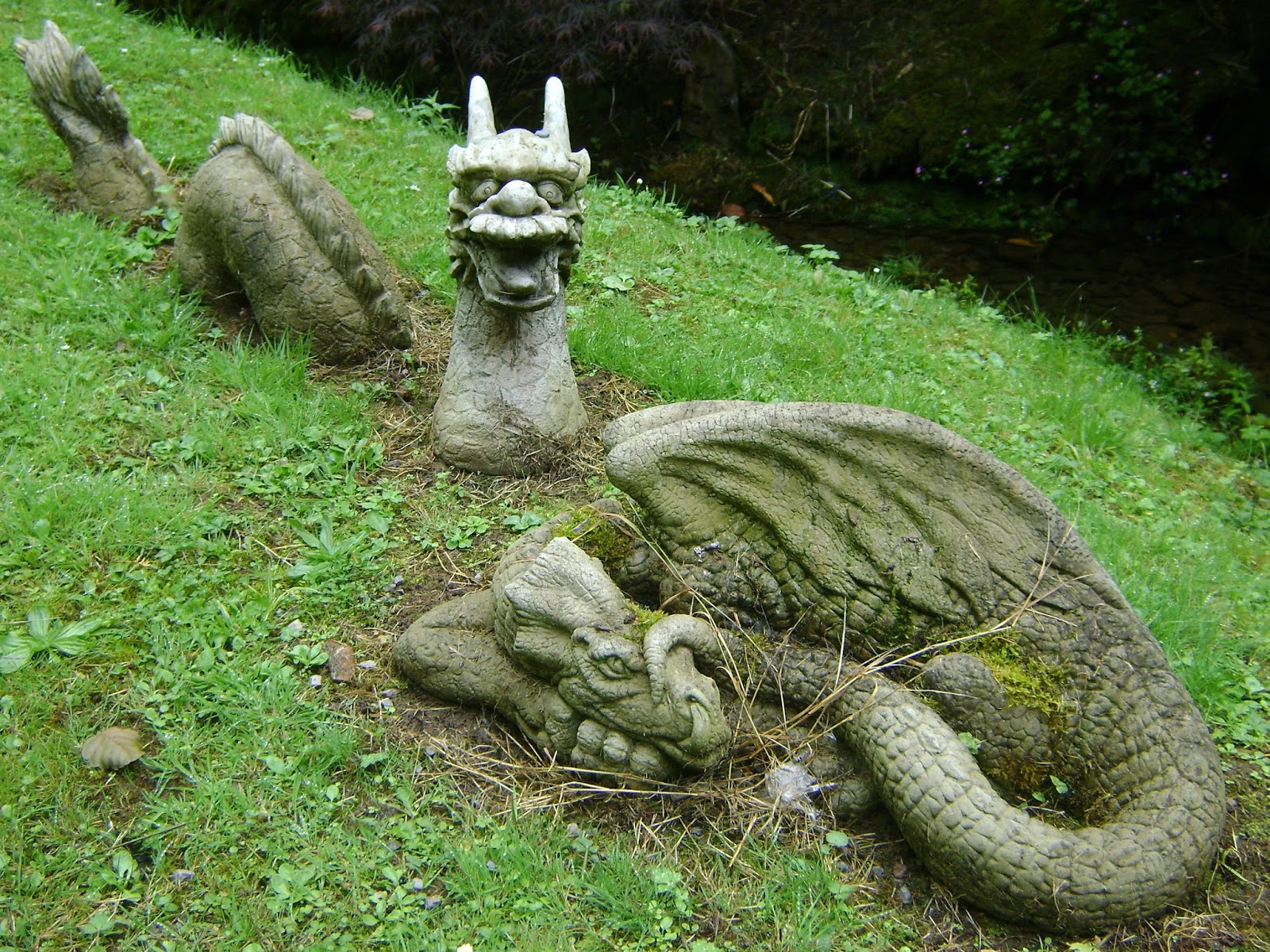
Which reminds me of a house near Callac that always makes me smile whenever I drive past and which I fully intend to use as an inspiration soon..


I am rambling, I do that a lot these days, when I am not intensely focused on some free online course or improving my language skills.

Back to Eden and the art work.
Like large insects among the flowers...


And this in the Rainforest Biome


And the wall paintings...
The work of  the Peruvian shamanic artists Montes Shuna and Panduro Baneo, they illustrate the link between the shamans and nature through Peruvian art.

I was very taken by the wall paintings. They are primitive yet powerful, and mysterious and magical. They remind me of the paintings at Lascaux and Chauvet's cave, created by ice-age artists to portray their world and, I believe but of course no-one knows, to draw on the power of the nature.

So here are some of the paintings...

The origin of ayahuasca and chacruna
When the powerful vegtalista  (a shamanic healer) Ayas was buried, the ayahuasca vine grew from his head and the chacruna bush from his hands. Ayahuasca is used by vegetalistas to contact the spirit world.


Dance of the spirits:
The spirits are rising from the earth, dancing for joy at seeing the plants and flowers; huarmi caspi which is used as a medicine by female healers, and sacha granadilla, serves as both a medicine and a perfume,


Spirit woman of the toe:
Leaves and flowers of toe or datura are smoked to relax the mind and to treat epilepsy. The sap from the stem and root are said to induce visions. This is a strong narcotic, over-use can be fatal.


Birth of the Spirits
When this spirit was born, so were two plants: tobaco bravo, to purify the place of birth, and camapnita del campo, to announce the birth. The sun and moon are seen giving energy to the birth of the spirit.


Spiritual Purification
Two plants, the canelilla and the huambisa chacruna are shown purifying the body. The body is covered in yellow clay to aid the spiritual purification process.


The Spirit of Chiric Sanango
As a teacher plant, chiric sanango has both male and female energy. It is used to treat arthritis and rheumatism. It increases energy and clears the mind.


More about the paintings can be found  here

And there is a wealth of information on the Internet about Peruvian shamanic rituals but I am not including any links. I have mixed feelings about such things, and there have been some serious accidents when people have taken part in purification rituals and drug-induced attempts to contact the spirits so I leave such things alone.

Besides which my mind is so fast-moving and randomly firing that I spend my time trying to quieten and control it rather than stimulate it.

But the scientist in me admits to being fascinated and curious...

And as I am so fond of telling The Ragazzi : A chacun son goût ....      


So, that's a brief look at the man-made treasures of the Tropical Biome.
Plants next and then The Mediterranean Biome


 .

Sunday, 17 July 2016

Feeling the Fear - Wookey Hole


People often tell me that I am 'so brave', 'inspiring', such a 'strong woman' and yet that's not me at all.
Truth to tell, I have spent most of my life feeling the fear and for the last eight years I've been engaged in a cycle of almost-paralysing anxiety.

But there comes a time when a person is done with fear and with running and decides, instead, to turn round and face their demons.

Small steps...
Checking the bank account towards the end of the month
Making an appointment for another health check
Saying 'No, I do not accept that' to someone in authority
Asking Those Questions of the oncologist
Petit à petit ...

We all have our demons and sometimes, in our imaginations, they become monstrous.
Unless we turn and face them and shout them down to a more manageable size
And then we often find they're not so bad after all.
N'est-ce pas?

Anyway, I have always suffered from claustrophobia, not just a fear of enclosed spaces and caves and the like, mine was so extreme that I was unable to have someone cover my head for more than a few seconds without panicking. Imagine the fun I've had with the MRI scans recently.

The year following my diagnosis, and nearing the end of treatment, it was time to tackle a few demons and this seemed like a good one.
Led by a guide and in the company of a dozen or so strangers, I went into Wookey Hole in Somerset.
I went underground.


You know what?
After an initial, "Oh my goodness, what was I thinking? I cannot do this! Let me out!"
And a few scared glances backwards towards the entrance
And a little deep breathing and heart-racing and clammy hands
It occurred to me that the voice screaming, "It's going to cave-in and you are going TO DIE!" was coming from inside of me and that I could say to that voice, "Oh shut up! I am going to die one day anyway, what the heck!"
For a few minutes I walked slowly behind the group muttering "Shut up" under my breath and then the screaming quietened to a whisper and though it never went away it didn't stop me.  


And then I started to enjoy myself.
And to revel in the adventure, me, scaredy-pants me, in a cave, underground


And then I got to imagining exploring and discovering cave paintings and I thought how wonderful the world below our feet really is ...


And how I'd spent almost sixty years being too scared to venture down there to see it


And that could have been sad, except that it made going underground on that day all the more special because I had faced the fear and conquered it. And learned a hugely important lesson.


We're born, we live, we die.
It's not the length of the life that matters, it's the depth.
And the demons , they're just there to give us something to overcome so that we can really feel alive!


Thursday, 14 July 2016

La Vallée des Saints

There is a hill not far from my local town in Brittany that is somewhat special.

It has been almost ten years since I bought my house and yet I was unaware of this place until a couple of friends took me there on our way back from a ladies lunch in Huelgoat.

As an after-thought.
As a 'let's pop to ...' on our way back.
As a 'Have you never been? How have you never been?'

And so we went. A brief visit because it had been a long day and we were all tired.
And the next day I went back alone to explore a little more.

La Vallée des Saints.


There are, I am reliably informed, around 64 saints currently in position on a hilltop near the village of Carnoêt. I would be more precise, but the guide book states that there were 64 in May and I am pretty sure that another one or two may have joined them in recent months, so 'around 64 will have to do'.

It is a work in progress, this peopling of the hillside with fifteen foot high granite statues. Every year sculptors arrive to work on new saints, the plan being to have 100 by 2018, all paid for by voluntary donations.


Visitors to the valley can see the sculptors at work, from a distance. They wear masks to avoid inhaling the granite dust and ear protectors because it's a noisy business, this cutting into rocks with electric saws and drills and whatever else they use, so sensible precautions and it's wise not to permit the public to wander too close.


At the top of the hill is a barrow. I am rather fond of barrows but on this occasion I didn't explore it. The weather was typically Breton, bright blue skies one minute, heavy storm clouds the next, and I wanted to see as many of the saints as I could before the heavens opened and washed me down into the valley.


So, without further ado, here are a few of the saints that I met on that day. Chosen for no particular reason other than that they 'spoke to me' and so this is a purely personal selection.

Saint Méen: Born in the 7th century to a wealthy family, raised in Wales, as were so many Breton saints, he travelled to Brittany and was so impressive a preacher that he was showered with money which he used to found monasteries, one near Rennes, another near Angers.  Méen and Samson (below) may have been related, many of the saints were, or else they knew each other and travelled together. Hardly surprising, there has always been safety in numbers and setting out to cross stormy seas with the intention of converting pagans is a risky enterprise.


Saint Paul (Pol) Aurélien: one of the seven 'founder saints of Brittany'. Another Welshman who apparently died in 575 at the age of 140, which leads one to suspect that folk confused several people with this chap. Some folk say he was a vegetarian, though I'm not sure why that matters. He was consecrated bishop by the authority of Childebert, King of the Franks. The sculptor has depicted him with a dragon at his feet since he was asked to rid the Isle de Batz of its nuisance dragon, for which service he was given land on the island upon which he founded a monastery. He died there on March 12th, 594. When the Norsemen invaded in the 10th century his relics were transferred to Fleury-sur-Loire for safe-keeping only to be destroyed by the Huguenots six hundred years later, Except, that is, for his arm bones, apparently.  


Quite a cute little guy. Symbolic, I daresay the original monster was somewhat larger.


Saint Malo; patron saint of Brittany Ferries, portrayed here carrying Le Bretagne that sails between Portsmouth and the city of St Malo. Seriously, no, the Welsh Saint Malo was another of the founding saints, and the first bishop of Aleth which became St Servan and then St Malo. He is said to have sailed the seas with Saint Brendan This guy is the patron saint of pig keepers and of lost items. There are legends around a lost island that sank into the sea, and talk of the Arabian Nights and Jonah.


Saint Samson: he arrived from Wales in the 6th century looking for peace and quiet near Dol de Bretagne. Saint Samson was a good politician who persauded Juval, son of a local tyrant, to overthrow his father and Samson duly became the bishop of Dol. Legend says that Samson's mother saved the life of a mermaid who had been captured on the seashore by a group of jealous women, mermaids being famous for luring men to their watery graves, and as a reward Samson's mum, who was past child-bearing age, fell pregnant. Which was a Good Thing for her.  Alas, the child was sickly so the mermaid returned and chucked him in the sea whereupon he emerged strong and healthy.  Et voilà, Saint Samson and the mermaid.


Saint Padern: A local lad who went to Ireland to train in the church before returning to be ordained as a bishop in Vannes. At the time, around 465, the new-fangled religion was not popular because it reminded the locals of the Roman invasion a few hundred years before and Saint Padern, who really only wanted a quiet life, left them pretty much alone. The serpent twisting round his cross represents the Christian symbol for evil and was used to remind people that sin is sweet and easily succumbed-to, as Adam and Eve discovered.


Saint Jaoua: Remember Pol Aurélien? This is his nephew. He was a monk, then a priest and then he was told to go and convert the pagans who were, as we know, not keen to be converted and who put up quite a fight. Jaoua persisted, sometimes by gentle means, sometimes using force, a pagan warlord and a dragon were involved, there was much mayhem, crops were destroyed, people were killed, before Uncle Pol patted the dragon on the head and told it to behave, whereupon the locals decided to become Christians after all.

His statue depicts another legend associated with Jaoua, namely that upon his death in 554 his body was placed on a cart harnessed to two bullocks who were let loose so that wherever they carried him he would be buried.


Saint Melar (Melor): The history of this saint is a little confusing, he seems to have been mixed-up with several others so we'll go with the Breton angle. It seems that Melor was a prince whose evil uncle, Riwal, having done-away with his father, then turned his attention to the child but was persuaded to leave him alone by the bishops. Not wishing to let him off Scot-free, Riwal cut off  the boy's right hand and left foot. The missing parts were replaced with a silver and a bronze prosthesis respectively which, while Melor was later off studying at Quimper Abbey, began to function as if they were flesh and bone, and to grow as the boy grew. If you look closely at the statue you can see the prostheses. Alas, when Melor was fourteen Riwal had him decapitated and that was that. \Rest assured, Riwal didn't get away with the murder, he touched Melor's severed head, presumably to assure himself that this time the boy wouldn't miraculously grow a new one, and as a result he died shortly afterwards.


Saint Tudi: We don't know much about Tudi, except that he was a disciple of Maudez and that he founded a hermitage on the island of Tudy which later transferred to Loctudy where it became a monastery. Some learned folk say that Tudi may be one of the founding saints under the guise of Pabu. I include Tudi because he can be invoked to cure rheumatism and in that I have a personal interest. And he looks like he's been half-buried in the grass.


Saint Konogan: Originating in Ireland, or Wales, or perhaps he was a local, his history is hazy, he's associated with the stone ship (Konogan's boat) in which he is said to have sailed to Brittany and which can still be seen at Beuzec-Cap-Sizun although it is, in reality, a fallen menhir. He established a monastery and lived as a hermit on the banks of a river, and was reputed to be a healer, especially of fevers. His sculpture depicts him standing in his boat, holding a cup of holy water to heal the sick who are shown on the side of the boat surrounded by protective symbols. Saint Konogan, like many other Breton saints, has not been recognised by the Catholic church.


Saint Goustan: This chap, another from Cornwall, was captured by pirates who mutilated his feet and abandoned him on the island of Hoëdic. Happily for him he had a fish from which he cut a slice every morning and which then reappeared whole the next day, so he's shown here with his fish. This theme of miracle fish is quite common in Christianity (think of the parable of the loaves and fishes).


Saint Tudwal: another of the founder saints whose name in Breton means person of valour or all-round good chap. He was another Welshman who learned the scriptures in Ireland before becoming a monk and somewhat of a hermit. Together with over seventy followers he moved to Brittany, established a monastery, of course and became the bishop of Tréguier. He's depicted with a dove because he was allegedly in Rome at the time of the death of the then-current Pope and the said-bird landed on his head which was a sure sign to all present that he had been chosen to be the next Pontiff. The story fails to explain why he didn't take up the appointment. Perhaps someone else also got the bird on that day.


So, those are a few of the saints. You'll have noticed a few themes - fish, dragons, Wales, monasteries and reluctant pagans. There's a whole lot more information about Breton saints which I am reading and researching and I'm hoping to return to the 'valley' (which is really on a hill) often, because it's an amazing place and it feels quite good for the spirit.


Here's the touristy info stuff:

La Vallée des Saints

Near Callac, Côte d'Armor

Entrance is free

There is a shop on site which sells excellent guide books, as well as other books about legends and myths and saints etc in Brittany. It also sells gifts for you to give to your loved-ones back home.

There are also toilets but no café/restaurant so take a baguette, cheese and a bottle of wine and have a picnic between the rain showers